Every licensed cannabis operation already generates a flood of data — METRC submissions, POS sales, Middleware logs, scanner events. Almost none of it gets read. Joint Venture is the intelligence layer that finally does.
In one sentence: an operational observability platform with a voice interface — you ask your operation a question out loud, and it answers from the systems you already run.
Not a chatbot · an intelligence layer on top of the data you already have
Presented by Bobby Brooks
METRC · Middleware · POS · Social Ads · Email & SMS → the intelligence layer → your bottom line
The problem
The industry is drowning in data and starved for answers.
Cannabis is one of the most heavily tracked industries on earth — every plant, every gram, every transfer logged into state systems. But logging data is not the same as understanding it. Operators collect enormous amounts of information and have no layer that interprets it. The signal is buried in the noise.
Today
Systems that record
METRC, POS, and Middleware each store what happened. To find a problem, a human has to already know where to look — and most of the time nobody does until an audit, a stuck manifest, or a discrepancy makes it expensive.
Joint Venture
A system that interprets
Ours reads across all of it at once, surfaces what's off before it costs you, and answers plain-language questions out loud. It doesn't replace a single system you run — it makes the operational signal audible to people who couldn't hear and understand it before.
Why we're different
The competition records. We run the business.
Every system the competition sells — the registers, the menus, the dashboards — ends the same way: a screen full of data and an operator who still has to find the problem, understand it, and fix it alone. We took the opposite side of that trade.
They sell software
We sell outcomes
The competition hands the operator another dashboard to learn. Ours reads everything, surfaces what matters out loud, and says what to do about it — no new screen to master.
They get ripped out
We sit on top
Replacing a register is a fight the competition has to win store by store. We replace nothing — we connect to whatever the operator already runs, so adopting us costs them none of what they've built.
They serve the shopper
We serve the owner
Where the competition has AI at all, it's a widget helping shoppers pick a product. Ours runs the owner's side — compliance, inventory, money — the half with the license and the P&L on the line.
They cover one state
We cover the map
Most of the competition is built around a single state system. This platform speaks the compliance language of dozens of jurisdictions, US and international — one brain, every market a chain grows into.
They stop at the store
We close the books
The competition's view ends at one location's register. Ours reconciles the whole chain — inter-company eliminations, group profit, the numbers a bookkeeper produces — automatically.
They write freely
We guard the record
Nothing touches a state record without review: every write is staged, human-approved, and logged. The competition treats state reporting as a button. We treat it like the license depends on it — because it does.
Where operational truth lives
METRC is the official record. Middleware is the truth.
METRC only sees what gets submitted successfully. The real operational story lives one layer down, in the Middleware and ERP systems that run the floor — the failed scans, the retries, the abandoned workflows, the timing delays, the corrections. The gap between what the state sees and what actually happened is exactly where the intelligence lives and is most important.
Operators are data rich but insight poor. Owners don't buy AI — they buy fewer compliance mistakes, smoother operations, and less audit risk. We sell the outcome, never the acronym.
What it catches
The mistakes that quietly become audit risk.
These are real operational failures the overlay is built to discover — the kind that slip past busy humans and turn into compliance exposure weeks later.
Compliance gap
Tag scanned, manifest not submitted
Product was tagged and scanned for transfer — but the manifest never went to the state. A silent gap until someone comes looking.
Discrepancy
Manual weight vs. scale reading
Harvest weight entered by hand doesn't match what the scale actually read. Flagged the moment the two diverge.
Audit risk
Destruction order vs. physical count
A destruction is logged in METRC but the physical product count doesn't line up. The single most dangerous kind of mismatch.
Human error
Same tag scanned twice
An employee double-scans a tag and no human notices. The overlay catches the duplicate automatically.
Stuck manifest
Transfer departed, never acknowledged
Product left the building but the receiving facility never acknowledged it. Left open, that's a compliance liability sitting in limbo.
And beyond
Patterns humans can't see
Dead-inventory prediction, unusual transfer behavior, batches showing patterns that historically precede discrepancies. Reasoning, not lookups.
How it works
You ask. It reads everything. It answers.
01
You ask in plain words
"What transfers haven't been acknowledged in 48 hours?" "Any harvest weights that don't match our scale records?" Out loud — no dashboards to learn.
02
It reads all four worlds
METRC, Middleware, POS, and the spreadsheets operators still run on the side. It correlates across every source at once.
03
It surfaces what's off
Discrepancies, stuck manifests, and anomalies get raised before they become audit exposure — proactively, not only when asked.
04
It teaches the questions
The hardest part isn't the tech — it's teaching people what to ask. The overlay suggests the operational questions most operators never knew were possible.
It's real today — not a slide. The voice agent is built and running on the same architecture behind our live production voice systems. You can pick up and talk to it.
Where the money is
"Sell more" is half the story. The other half is the money leaking out the back.
Every owner says the same thing — sell more. But no owner actually wants more sales; they want more money in the bank, and those aren't the same. Money is made two ways: bring more revenue in, and stop the money quietly bleeding out. The register only touches the first. Joint Venture works both — and the second is where the biggest money hides, because until something reads the data, nobody ever sees it leave.
Bring more in
Sell more
Win back the three-in-four customers who came once and never returned. Put your top budtender on the busy days. Fill the dead hours with the right promo. Repeat the discounts that actually made money and kill the ones that gave margin away. Never run out of your best sellers.
Keep more
Stop the leaks
Free the cash frozen in dead product on the shelf. Catch shrinkage, miscounts and short shipments while they're small. Flag audit risk before it becomes a fine that costs more than a year of the platform. See which vendor is quietly shorting you a third of every order.
Win-back
The customers who never came back
Three in four buyers visit once and vanish. It finds them and hands you the highest-ROI move in retail — a first-return offer sent straight to people who already know you.
Your closers
Put your best seller on the busy day
It shows who rings the biggest baskets and who doesn't — so you schedule your top budtenders when the traffic actually is, and coach the rest up to match.
Trapped cash
Dead stock is money on a shelf
Product that isn't moving is cash you can't spend, aging toward worthless. It spots it early so you can move it while it's still worth something.
Leak detection
The money bleeding out unseen
Shrinkage, double-scans, miscounts, destruction that doesn't match the count — the small losses that quietly add up. Caught automatically, before they compound.
Your vendors
Who's quietly shorting you
It scores every supplier on short shipments, late transfers and bad product — so you renegotiate or drop the one costing you a third of every order.
What sells next
Never miss a sale you could've made
It forecasts demand and flags when a top seller is about to run dry — because every stockout is a customer who walks out and buys somewhere else.
A register rings up a sale. It can't tell you that cash is frozen in dead stock, that a vendor is shorting you a third of every order, or that you're one manifest away from a fine. That money is already yours — the platform just finds it.
Strain Brain
Seed-to-sale tracks the plant. Strain Brain understands it.
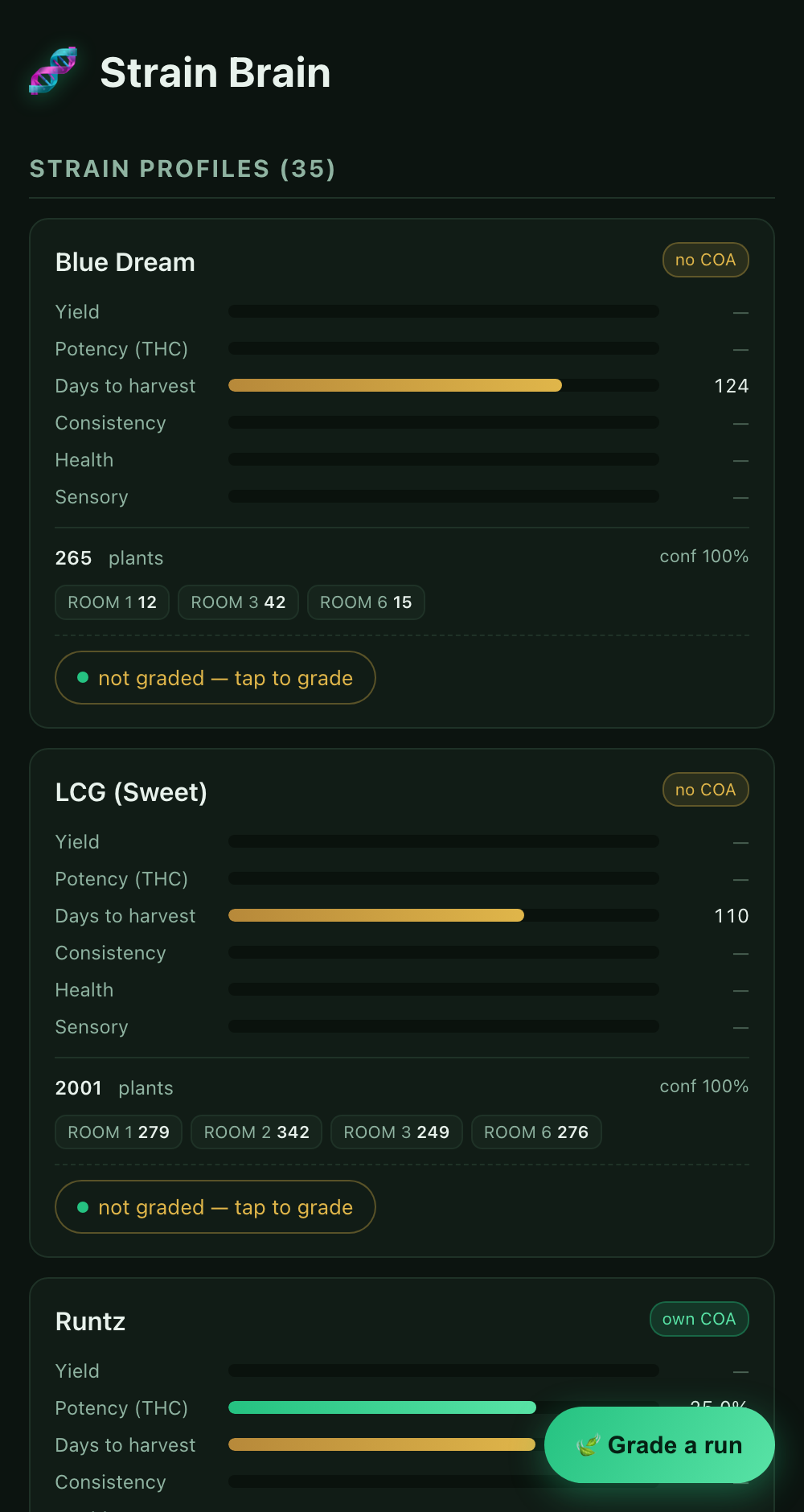
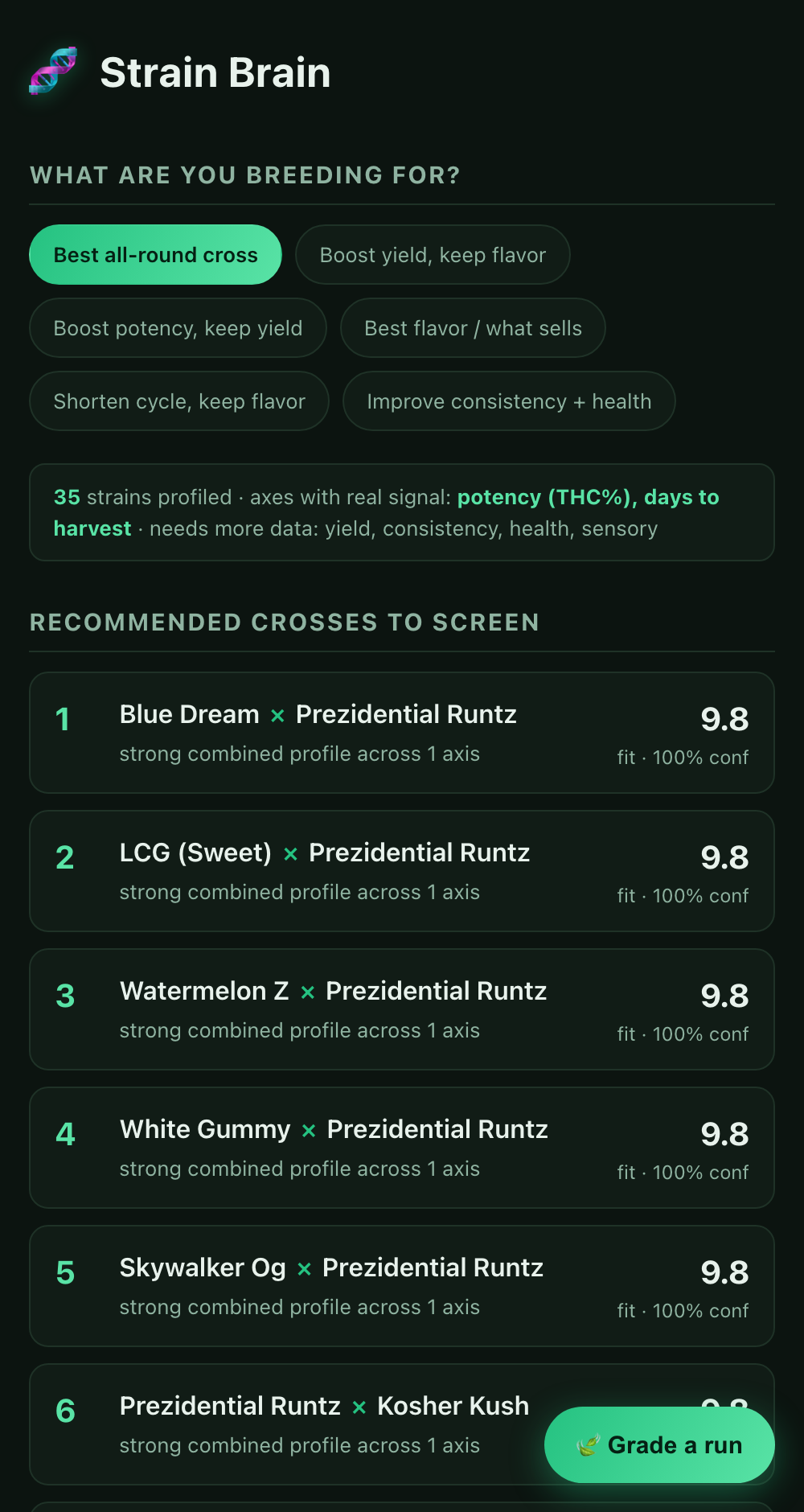
Every grower already sits on years of cultivation records — plants, harvests, yields, cycle times — plus the lab COAs they paid for and never read again. Strain Brain reads all of it and turns it into breeding intelligence: it profiles every strain you have ever run on real numbers, then tells you which two strains to cross, and why.
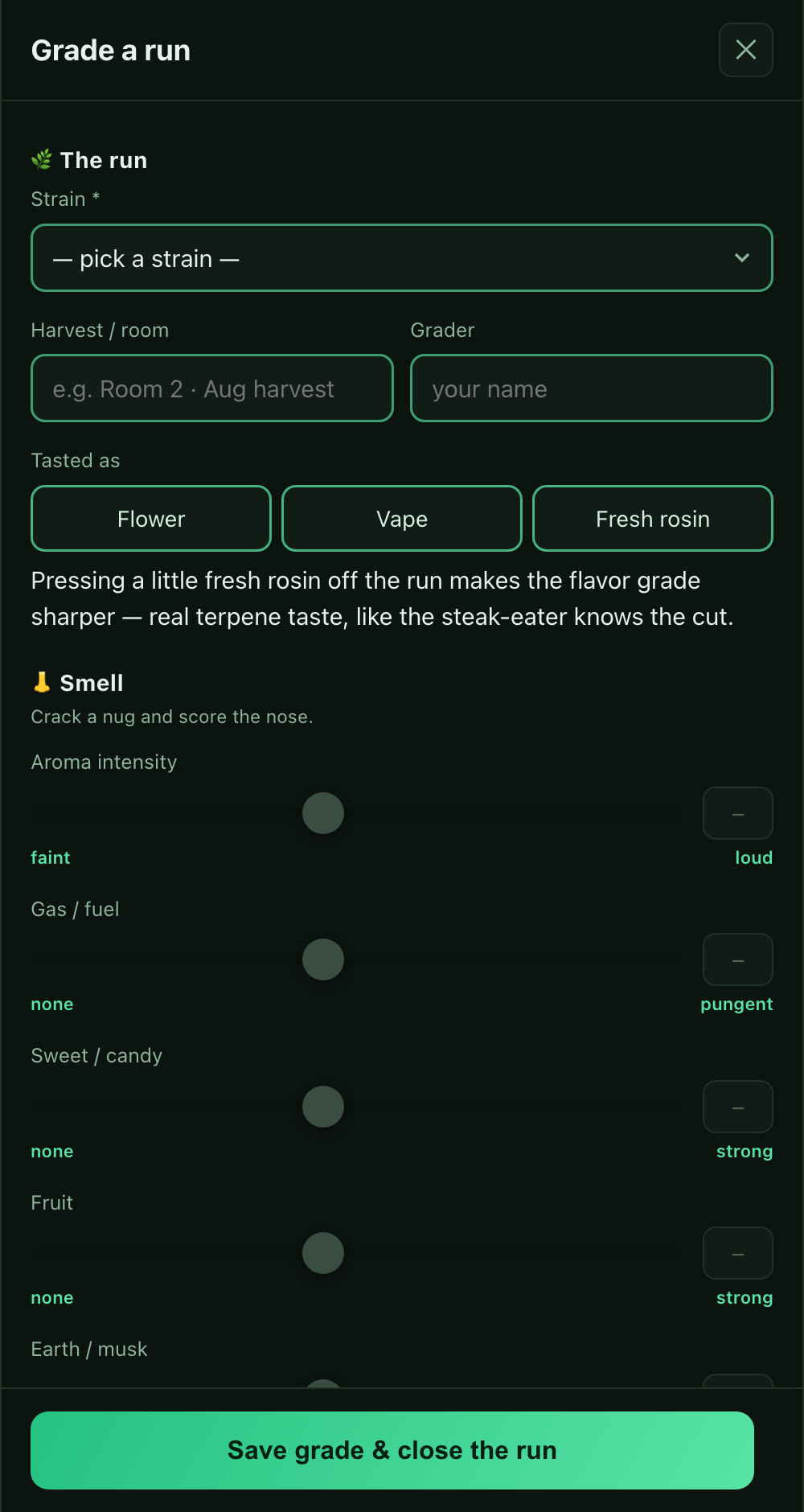
And it captures the one signal no lab and no state system will ever have: your own senses. A phone-first grading form built for the trim table — smell, flavor front and center, the hit, the high, bag appeal — plus the two decisions every grower already makes out loud and never writes down: "would I run it again?" and "what will it sell for?" Your grade closes the run.
01
Every strain, profiled
Yield per plant, days to harvest, THC from your actual COAs, consistency, plant health — real units a grower trusts, ranked within your own grow. Blank is honest: it never fakes a number it does not have.
02
Graded by the human
Tap the flavor notes present — grape, gas, citrus, cream — rate the loud ones, add your own words. The platform learns your language and ties it back to the chemistry. A grower’s nose fills in for a terpene panel they never bought.
03
Which cross, and why
Pick the objective — best flavor, biggest yield, fastest cycle, potency — and it scores complementary parent pairs from your own data. Grow the offspring, grade it, and the loop closes: it gets smarter every run.
01 · Every strain, profiled02 · Graded by the human03 · Which cross, and why
The real panel — live in the app today, shown on a working grow.
It runs on truth. Strain Brain only performs on honest data — which is exactly why operators who keep clean records win with it. Your truthful history becomes a compounding asset no competitor can copy.
Your own ad agency
It runs your operation — then it becomes your ad agency.
This is far more than "make a video." The same voice that answers your operational questions is a complete marketing studio — an entire ad agency in the palm of your hand. Describe a product out loud and, minutes later, you have a finished, broadcast-quality vertical video ad — branded, voiced, scored, and ready to run. No editor, no agency, no shoot, no retainer.
And it isn't generic. Behind it is a brain that learns your brand. Feed it your logo, your packaging, your product shots, and it studies them — pulling your colors, your typography, your whole visual signature — and remembers it as your brand, kept separate from every other operator's. From then on, every ad it makes comes out unmistakably yours. The more you use it, the sharper it gets. It even learns and saves named campaign looks you can reuse — a "Luxe Drop" style, a "Street Launch" style — so your marketing stays consistent when you want it consistent and fresh when you want it fresh.
◆
A brain that learns your brand.It studies your logo, packaging and product images and learns your palette and style, per account — so ads look like you, not a template. It keeps a memory of what it's learned and gets smarter every time you use it.
◆
Say it, and it builds it."Make an ad for our Blue Demon pre-rolls — new drop." In a couple of minutes: a polished 9×16 video with your logo, an optional spoken voiceover, and your brand's theme music mixed underneath.
◆
It posts everywhere for you.Straight to your Instagram, TikTok, YouTube, Facebook and X — from one place, whenever you want to drive traffic. One voice command out to every channel.
◆
Guardrails so you never get flagged.Cannabis accounts get banned for the wrong word or the wrong image. Every social ad is screened first against each platform's rules — no depicted consumption, no prices or discounts, no health claims, no potency claims, 21+ only. If something would get you flagged, it's caught before it ever posts.
Channel 1 · Social media
Compliant by design
Ads headed to Instagram, TikTok, YouTube, Facebook and X are built to each platform's cannabis rules automatically — brand and vibe, no pricing, no claims. Your accounts stay safe, so you keep the audience you've built.
Channel 2 · Email & text blast
Wide open
To your own opted-in customers, the gloves come off. Prices, deals, discounts, potency, hard "shop now" calls to action — the full-strength adult-use promotion the platforms would ban. Because these go out through your own email and text list, not the social sites, there are no content restrictions holding you back.
Two channels, one voice: brand-safe ads for the platforms, and no-holds-barred deals straight to the customers you already own.
Reach your customers
It builds the ad — then it sends it.
The platform doesn't stop at making the video. It pulls your customer list straight from your POS and pushes your promotion out by email and text message — from the same voice, the same place. The ad you just created becomes a blast that lands in every customer's inbox and phone, opt-out and compliance handled for you.
01
Your list, already there
Customers pull in automatically from your POS — no exporting, no spreadsheets. The people who already shop with you, ready to reach.
02
Email and text, one send
"Blast Friday's drop to my list." It goes out by email and SMS at once — your new ad linked in, headed straight to phones and inboxes.
03
Compliant by default
Every message carries an opt-out, STOP is honored automatically, and sending is throttled to stay clean — so your promotions never get you flagged.
Create the ad, then put it in front of every customer you already have — email and text, from one voice.
Prove what worked
It sends the ad — then it proves which one made you money.
Every other ad tool stops at likes and views. Joint Venture is the only one that already reads your register — so it closes the loop all the way to revenue. Every campaign it creates is tagged and tracked from the first click to the final sale, and it tells you the one thing that actually matters: which ad made the store money.
01
One tag on everything
The video, the email, the text and the link all carry one campaign ID — so a whole campaign is one connected thing, tracked start to finish.
02
Every click, counted
Each link runs through the platform first, so it counts the clicks itself — no begging Instagram or TikTok for numbers they never give cannabis accounts.
03
Clicks tied to real sales
Because it reads your POS, it matches each campaign to actual transactions and revenue — promo codes exactly, in-store lift measured against a control store.
Stop guessing which post "did well." Ask it straight: "Which campaign made us the most money?" — and get a real number back.
Setup & support
You're never handed software and left on your own.
Most operators aren't technical, and their systems are a tangle of METRC, POS, Middleware and spreadsheets. So every operator is set up in person by a trained specialist — connected, configured, and shown how to use it — for a one-time custom onboarding fee, the way you'd have a new phone set up before you leave the store. After that, that same specialist stays your ongoing, personal support.
First-time setup
Done for you, on-site
A specialist comes in, connects your systems, cleans up the data, and gets the intelligence running — a one-time custom onboarding, like setting up a new phone.
Personalized training
Your people, taught to use it
Owners and staff learn what to ask and how to act on it — not a manual to read, a real person working alongside your team.
Ongoing
A real person on call
Your specialist stays your dedicated support going forward. You always have someone who already knows your operation.
This isn't software you're left to figure out — it's a system that comes with a person who sets it up and stays with you.
Choose your level
One platform, built to fit any operator.
It scales from a single dispensary to a multi-license operation. Start with the core intelligence, add the marketing studio when you want it, and step up to a fully branded edition of your own.
Core
The Intelligence Platform
The voice agent, the operational intelligence across all your systems, and personalized on-site setup and support. Everything an operator needs to finally see their own business clearly.
Add-on
The Marketing Studio
Switch on voice-created video ads that post to your social accounts. Add it on top of the core platform whenever you're ready to drive traffic.
Custom
Your Own Branded Edition
Want the whole thing to carry your name and look? A one-time custom build delivers a white-labeled version that feels entirely your own — with dedicated support to match.
The offer
You deploy it. You monetize it. We both win.
This is not a sale, a license, or a handoff. The overlay stays ours. A partner who already reaches the operators — a POS platform, a state-tracking system like METRC, or a network and community the industry already trusts — deploys it through relationships they already have and monetizes it. We earn on every deployment. They don't have to build AI, figure out what operators need to ask, or prove anything. That work is done.
The partner brings
Operators & distribution
The locked-in operator base and the existing relationships. Nothing new to build — just switch on the layer their competitors don't have.
We bring
The intelligence
The overlay, the operational reasoning, the voice interface, and the proof. Already built, already reasoning across real cannabis data.
The clock
First mover wins
Operators won't leave a platform that thinks for them. Whoever deploys this first becomes the platform with AI while none of their competitors have it.
The proof
One trusted operator. Real data, real compliance.
The pilot is a real operator running a licensed grow and distribution business in Los Angeles — multiple business types under one roof, so the system proves itself across grow and distribution against genuine METRC data and genuine compliance requirements. Not a simulation. Live operational proof before a single partner conversation.
The market
Thousands of operators. Every AI locked in its own walls.
State-mandated seed-to-sale tracking means thousands of operators across dozens of states are required to run these systems, and every one of them is generating operational data. A wave of AI tools has started appearing to read it — which proves the demand is real. But each one is trapped inside a single platform, built for the register, and tied to whichever vendor built it. The operator who runs on more than one system — which is all of them — still has no independent layer that reads across everything and answers out loud. That's the opening.
41
States & territories on mandated tracking
Thousands
Licensed operators per platform
$199/mo
Per operator subscription
Independent
POS-agnostic — no vendor lock-in
Jurisdiction count is the United States footprint alone — the combined METRC, BioTrack, and state-run track-and-trace systems shown on the map below. On top of that the platform speaks seven national regulators outright: Canada, Germany, the United Kingdom, the Netherlands, Australia, Brazil, and Thailand. Operator counts run into the thousands in large markets — California alone has over 7,700 active licenses. Pricing is illustrative and set with each partner.
Where it works
Live today — and rolling out state by state, country by country.
The overlay runs anywhere operators are required to report into a government seed-to-sale system. We hold API integrator production access in California and nineteen more METRC states — Oregon the latest — and the platform reads BioTrack's state systems too, so operators across seven more jurisdictions connect their own BioTrack account directly. Integrator access is filed and expanding across the rest below. Beyond the United States the platform speaks six more national regulators outright — Canada, Germany, the United Kingdom, the Netherlands, Australia and Brazil — each built against that regulator's own filed forms: Australia's quarterly Office of Drug Control return on the ODC's own workbook, and Brazil's BSPO balance on ANVISA's, filed through Solicita. Each new market comes online with no change to the product.
Live — integrator access BioTrack — operator connect State-custom modules — no Metrc, we are the system of record: Washington, Arizona, Pennsylvania, Utah, Vermont, Georgia CSV only — the licensee uploads, no API integration required: Alaska, Missouri, Nevada, Ohio, Rhode Island, West Virginia
California and nineteen more METRC states — Oregon the latest — have API integrator production access granted and are open for operator onboarding (no operators live yet). Seven BioTrack jurisdictions (Arkansas, Connecticut, Delaware, Florida, Hawaii, New Mexico, Puerto Rico) connect at the operator level with no statewide gatekeeping. Washington is live on CCRS — the state’s own reporting system, which replaced METRC there — through the platform’s first state-custom compliance module. Arizona mandates no statewide system at all — operators keep their own records under R9-17-316 and file a monthly MET-1 excise return to the Department of Revenue, which the platform generates outright as its second state-custom module. Florida runs BioTrack for the state and requires a licensee’s own system to hold a live API session with the Department’s, so the platform carries Florida’s full thirty-three-event obligation. The remaining seven METRC states run on the CSV lane — the platform generates the state-format file and the licensee uploads it under their own login, so no API integration is required. Each switches to full integrator access as Metrc approval comes through. The platform is built to run in every METRC and BioTrack state — additional markets come online as access is granted.
Health Canada’s Cannabis Tracking System is federal, so one module covers the whole country. Retail is provincial: Québec, New Brunswick, Nova Scotia and Prince Edward Island run government retail monopolies, so operators there are producers rather than shops.
CTS live — monthly report + B300 excise CTS live — government retail monopoly, producer clients only
Canada has no METRC. Federal licence holders file one monthly Cannabis Tracking System report per licence, due the fifteenth, built here from Health Canada’s own 2,329-column reporting template. Excise duty and provincial stamps are carried on the B300 worksheet, and Québec’s advertising rules are enforced separately from the rest of the country.
Europe — three national regulators live
No European country uses METRC. Each of these was built against the regulator’s own published forms and statute, in that country’s language.
National regulator module — live Roadmap
Germany files annual reports to the BfArM on the BfArM’s own forms, with the MedCan number’s check digit validated exactly as their spreadsheet computes it, plus cultivation-club reporting under the KCanG. The United Kingdom files the Home Office annual return built from the Home Office’s own workbook, alongside the controlled-drug register. The Netherlands has no annual filing at all — it is continuous track-and-trace, with the register fields taken verbatim from the Regeling. Northern Ireland is deliberately excluded — it runs its own Misuse of Drugs Regulations (NI) 2002 and is on the roadmap rather than live. Each module ships with that country’s advertising rules and interface language.
Connects to your stack
Whatever you already run, it reads across it.
Neutral by design. The overlay plugs into the systems operators already use and correlates them into one picture — compliance, point-of-sale, back-office middleware, and cultivation sensors together. No rip-and-replace, no vendor lock-in.
Compliance / track & trace
METRCBioTrackCCRS WashingtonADOR MET-1 ArizonaOMMU STS FloridaCTS CanadaBfArM GermanyHome Office United KingdomTrack & Trace NetherlandsODC AustraliaANVISA BSPO Brazil
Any combination, correlated into a single view — plus direct CSV and spreadsheet import for the records that live outside a system.
Why now
The category just proved itself — and started the clock.
In mid-2026 the biggest names in cannabis tech began shipping AI — the largest POS launched a consumer AI suite that answers the store's phone and upsells shoppers at the register, and the rest are racing to follow. For years this market didn't exist; now it's real and moving fast. But look closely at what it does: every bit of it is built to sell to your customers. None of it is built to tell the owner where the money is going. That's the blind spot — and the countdown to own it is measured in months, not years.
The wave
AI that sells to your shoppers
The new cannabis AI faces the customer — answering calls, pushing upsells at checkout, working the online menu. It grows the top of the funnel, inside one vendor's walls, retail only. Useful. But it can't see a discrepancy, a shorted vendor, dead cash on the shelf, or a stuck manifest.
The gap we own
AI that watches the owner's money
One neutral layer that faces the owner — reading across METRC, POS, middleware and spreadsheets to find the sales you're missing and the money you're losing, in the grow room and on the loading dock, not just the register. Whatever POS you run, $199 to switch on. First mover into that gap owns it.
Two businesses in one
Software at scale — training pays first.
The overlay is the asset. But a second business funds the first and pre-sells it: teaching operators how to think with operational intelligence. It needs no software to start, delivers value immediately, and turns pilot operators into industry trainers who create inbound demand for the platform.
Stream 1
Operational overlay
The SaaS platform — a recurring subscription per licensed operator, deployed through the partner.
At scale
Stream 2
Literacy & training
Delivered personally at first. Immediate revenue, no software required, builds the network that sells the platform.
Revenue first
The flywheel
Trainers become demand
Trained operators become industry trainers — a multiplier that pre-sells the software to everyone they teach.
Compounds
The financials
How it makes money, and how it grows.
A recurring subscription for every operator running the overlay. Operators stay because a platform that thinks for them is one they can't afford to leave — which makes the revenue sticky and the operator hard to poach.
Scenario
Operators running it
Revenue / year
Early
500
$1.19M
Growing
2,000
$4.78M
Strong
10,000
$23.9M
At scale
20,000
$47.8M
Illustrative at $199 per operator per month — final pricing is set with each partner. Training and consulting revenue is additional and arrives earlier.
Confidential
The layer is the asset — and it's ours.
The overlay is platform-agnostic: it works the same whoever deploys it. The partner changes; the product doesn't. How it connects, correlates, and reasons is not disclosed here — full details are shared only under a signed NDA.
About the developer
A studio veteran who builds the future.
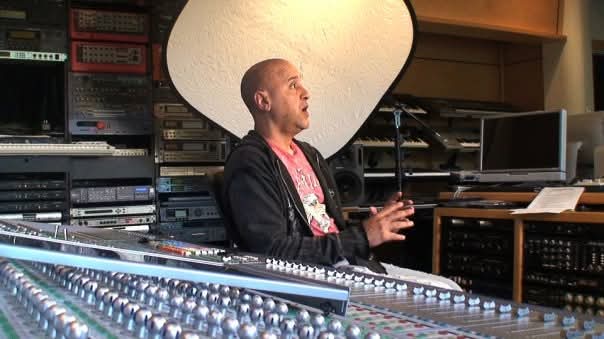
Robert "Bobby" Brooks is a veteran recording engineer, producer, and music educator with over 45 years in the music and entertainment industry. A former staff engineer at Motown's Hitsville Studios and the legendary Universal Recording Corporation in Chicago — and longtime personal recording engineer for Stevie Wonder, Rick James, Michael Jackson, Ice-T & Body Count, Teena Marie, Whitney Houston, Black Sabbath, P.O.D., Herb Alpert, Quincy Jones, Lionel Richie, Ray Parker Jr., Tina Turner, Snoop Dogg, and many more — he brings firsthand knowledge of professional music creation across studio, live performance, film, broadcast, and touring, spanning analog, digital, and immersive audio workflows.
Today Bobby is also a software developer, inventor, and futurist — the creator of the patent-pending platform that powers this app, Sentient Systems Labs™. It learns how an expert works and lets them run complex systems in plain language, and it reaches well beyond cannabis into fields as varied as medical imaging, robotics, drone control, and the culinary arts. Inside Joint Venture the same technology shows up in two forms: the ad studio that learns your brand's style, and the intelligence that reads your operation back to you.
A dedicated educator, he also teaches music fundamentals, recording technology, sound design, mixing, and production — with a focus on clarity, confidence, and real-world application.
"If you can touch a knob, you can make a sound — and if you understand the language of music, you can create with purpose."
Selected credits: Michael Jackson, Stevie Wonder, Prince, Whitney Houston, Quincy Jones, Bruce Swedien, Jimmy Jam & Terry Lewis, Rick James, Teena Marie, Andre Cymone, Jody Watley, Ice-T & Body Count, Black Sabbath, P.O.D., DeBarge, The Notorious B.I.G., The Fugees, Layzie & Krayzie Bone, 2Pac, Maurice White, Mariah Carey, Stanley Clarke, Brandy, Berry Gordy, Smokey Robinson, Patrice Rushen, The Temptations, Third World, Eddie Murphy, The Dazz Band, George Duke, Billy Preston, Chaka Khan, MC Hammer, Def Leppard, Gerardo, Diana Ross, Herb Alpert, Lionel Richie, Ray Parker Jr., Tina Turner, Snoop Dogg, Nate Dogg, Motörhead, Common, Baby, Sepultura, Dionne Warwick, Aaliyah, The Jacksons, and Ray Charles.
Whoever moves first has AI when none of their rivals do.
The intelligence layer cannabis has been missing is built, reasoning across real operational data, and ready to deploy. The overlay stays ours; the partner brings the operators; both sides monetize. The only question is who switches it on first.
Bobby Brooks · bbthemixmaster@gmail.com · (818) 376-9966